


Your cart is currently empty.
Rug Buying Guide
I’m Kevin, product manager at Houlte with 15 years in the rug industry. People ask me this all the time: “Why does an area rug cost so much?” The honest answer is: a rug isn’t a small décor item — it’s a large-scale engineered textile that carries material, labor, design, and logistics costs all at once. In this guide, I’ll show you what you’re paying for, what’s worth paying for, and how to buy smart.
Rugs are expensive because they require a lot of raw material (often 50–120+ sq ft), multiple manufacturing stages, finishing work (edges/backing), and expensive shipping due to weight and volume. Higher-quality rugs also use better fibers, denser construction, improved color/pattern development, and stronger finishing — all of which cost more but typically last longer and look better over time.

| Cost Driver | Why It Matters | What “Good” Looks Like | Red Flags |
|---|---|---|---|
| Fiber & Yarn | Material quality affects feel, resilience, shedding, and longevity. | Wool / wool-blend with a substantial hand-feel. | Very thin fibers that flatten quickly. |
| Construction & Density | Density controls how well a rug holds shape and hides wear. | Tight, even surface; edges hold straight. | Loose tufts; “wavy” edges out of the box. |
| Finishing | Binding/serging and backing determine durability and curl resistance. | Clean edges, stable backing, lies flat. | Corners curling, uneven binding. |
| Dye & Pattern Development | Color accuracy and pattern balance take testing and iteration. | Depth + clarity in design, not flat printing. | Muddy pattern, inconsistent tone. |
| Logistics | Rugs are bulky and heavy; delivery costs are real. | Protected delivery + careful packaging. | Arrives bent, creased, poorly protected. |
Rugs feel expensive because they’re huge. You’re buying floor coverage, not a small accessory. Here’s how quickly area grows:
| Size | Area (sq ft) | What That Means |
|---|---|---|
| 5×8 | 40 | Small living rooms / compact zones |
| 8×10 | 80 | Most common “anchor” size for living rooms |
| 9×12 | 108 | Large rooms / open concept / sectionals |
Notice how 9×12 isn’t “a little bigger” than 8×10 — it’s 35% more area. More material, more backing, more shipping, more labor. That’s why prices jump.
Here are the checks I use when evaluating a rug quickly. These are practical, not “marketing.”
Curling corners usually signal weak finishing or thin backing.
Uneven tuft height and ripples show inconsistent construction.
Movement + texture disguise crumbs, lint, and traffic paths.
If it feels “paper thin,” it won’t age well in busy rooms.
Most shoppers don’t regret buying a better rug — they regret buying the wrong size or a rug that doesn’t live well. If you’re shopping with durability and real-home practicality in mind, explore our curated Houlte collections:
| If it’s expensive, you should get… | If it’s overpriced, you’ll often see… |
|---|---|
| A rug that lies flat and holds shape | Curling corners and shifting edges |
| Texture/pattern depth that ages well | Flat look that shows every mark |
| Consistent finish (binding/backing) | Uneven seams or thin backing |
| A clear return/exchange path | Hard-to-resolve customer experience |

Wool is a natural fiber with better resilience and structure than many synthetics. It typically feels more substantial, handles traffic better, and maintains appearance longer — which raises raw material and production cost.
In living rooms, a too-small rug is the #1 regret. If your layout allows it, sizing up usually makes the room feel more cohesive. The only time bigger is not better is when it crowds walls or blocks door swing/vents.
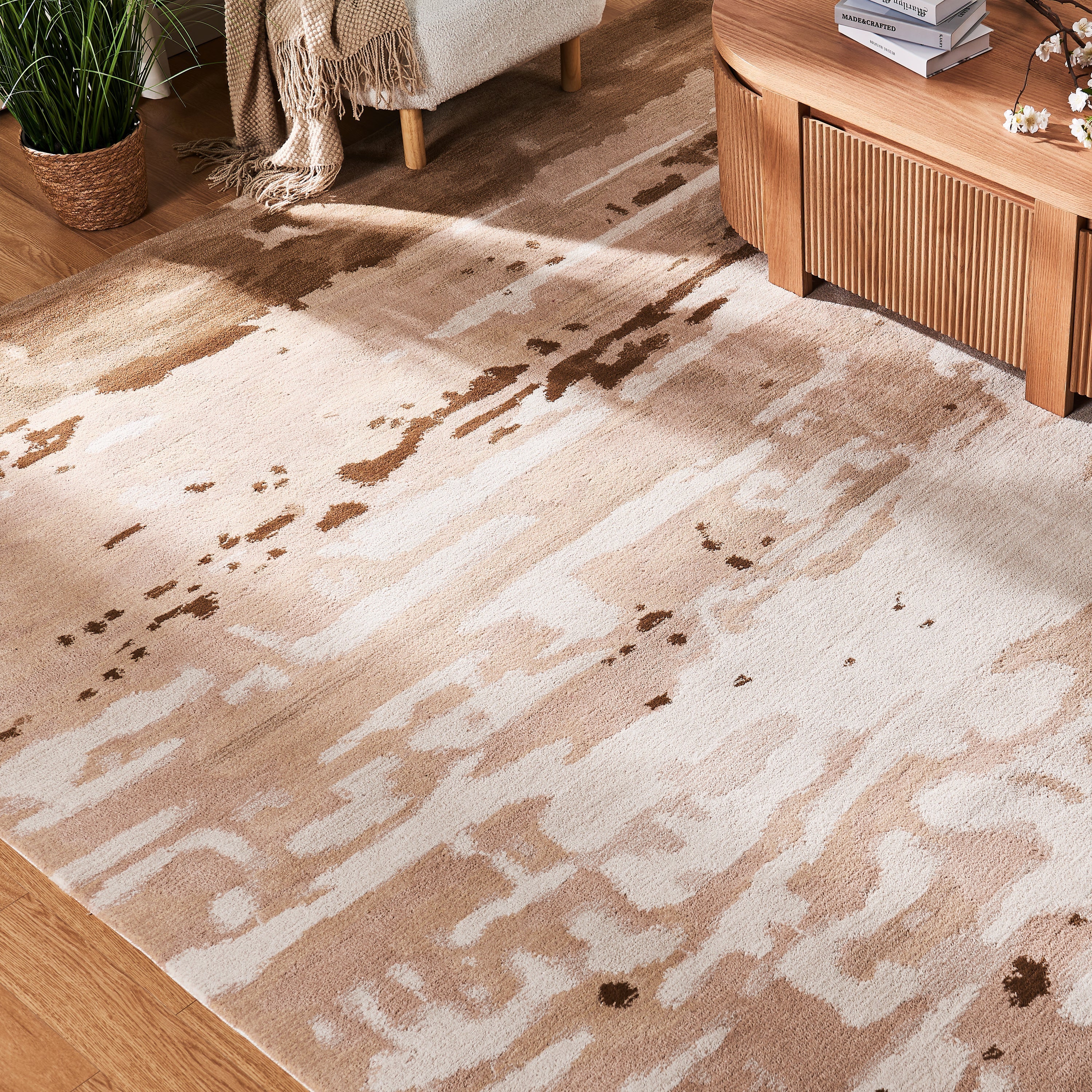
Look for movement and texture — etched patterns, subtle marbling, sketch lines, and mixed tones. They’re simply more forgiving in real homes than perfectly solid, flat-color rugs.
For many standard living rooms, 8×10 is the most versatile anchor size. For large rooms or sectionals, 9×12 often looks more correct. If you’re in a smaller space, 5×8 can work when furniture scale is compact.
Rugs are expensive because they’re big, material-heavy, and complex to make well. The best way to feel good about the spend is to pick the right size first, then choose a construction and pattern that suits your daily life. If you want to start browsing with confidence, begin with our Rug Collection and then narrow by room and size.
Resin vs. Alabaster Lighting: Which Material Is Right for your Home?
Read moreabout Resin vs. Alabaster Lighting: Which Material Is Right for your Home?
From Sconces to Statement Chandeliers: What Resin Makes Possible
Read moreabout From Sconces to Statement Chandeliers: What Resin Makes Possible
The Case for HOULTE Resin Lighting in Real Homes
Why does HOULTE resin lighting work so well in real homes? Explore its stone-inspired character, practical care, flexible forms, room-by-room applications, and the details to verify before choosing a fixture.
Read moreabout The Case for HOULTE Resin Lighting in Real Homes
Share:
How Big Is an 8×10 Rug? Dimensions, Room Fit & Real-World Examples
2026 Furniture Trends: The Ultimate Guide to Modern, Elevated Living